


Learn Korean Through Stories and Pictures: Why Visual Vocabulary Sticks
Have you learned the Korean word 쌀쌀하다?
쌀쌀하다 means “to be chilly” and is commonly used to describe weather that feels slightly cold.
You could memorize it like this:
쌀쌀하다 = (weather) to be chilly
Simple enough.
But what if, instead, you met a ridiculously handsome Korean webtoon guy walking dramatically through the autumn leaves?
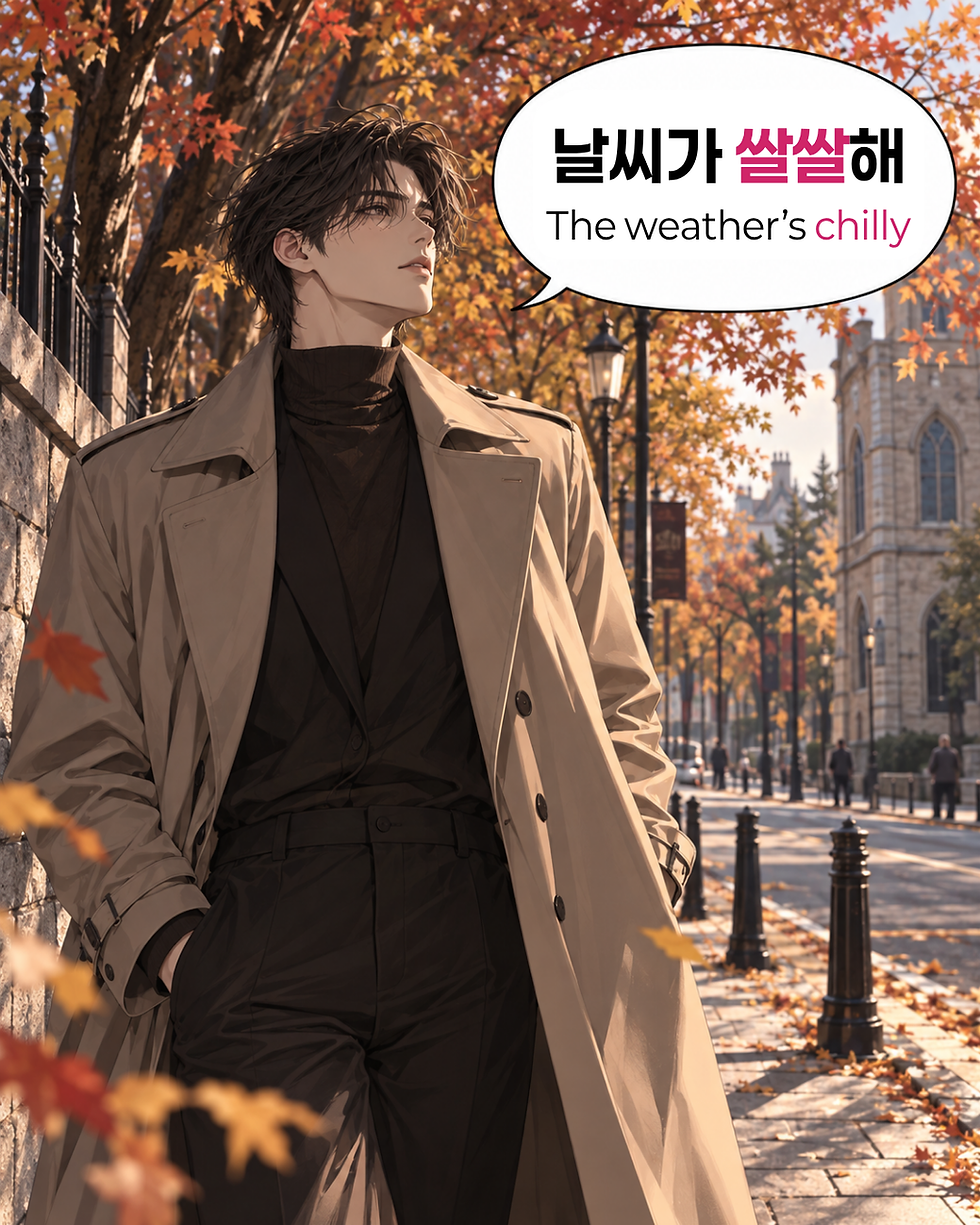
He puts on a trench coat. He stares wistfully into the distance.
날씨가 쌀쌀해.
The weather’s chilly.
Then he realizes something important.

가을이 왔네.
Fall is here.
So far, we are still in a perfectly respectable K-drama. Unfortunately, it doesn't last long.
How Can a Funny Story Help You Remember Korean Vocabulary?
Our unnecessarily handsome hero suddenly remembers:

가을은 수확의 계절이지.
Fall is the season of harvest.
Naturally, he goes looking for rice. Because apparently that's where this Korean lesson is going.

And there it is:
쌀 = rice
Not one bag.
Two.
And our hero carries them away with exactly the same unnecessarily serious K-drama expression.
What Does 쌀쌀하다 Mean in Korean?

쌀 + 쌀 → 쌀쌀
쌀은 쌀쌀한 계절에 수확한다.
Rice is harvested in the chilly season.
And before anyone reports me to the Korean language authorities:
No, 쌀쌀하다 does NOT actually come from 쌀 + 쌀. 😂
It's just a silly visual pun. Now, you won't forget 쌀쌀하다. That's exactly the point.
Why Is It Easier to Learn Korean Vocabulary in Context?
When you learn Korean vocabulary from a list, a word can feel arbitrary.
You see:
쌀쌀하다 = chilly
You memorize it.
A few days later, you see 쌀쌀하다 again and think:
Wait... I know this word...
But learning Korean vocabulary in context gives your brain more information to connect to the word.
In this story, you don't have only:
쌀쌀하다 = chilly
You have:
쌀쌀하다 → chilly weather → autumn → trench coat → dramatic K-drama guy → harvest → rice → two bags of 쌀
The connection is ridiculous.
That's why it works.
A memorable story gives an unfamiliar Korean word something familiar to attach itself to.
Why Learn Korean Through Stories and Pictures?
When you learn Korean through stories and pictures, vocabulary becomes connected to scenes you can actually visualize and remember.
Pictures give you another way to understand and remember Korean.
Think about 쌀쌀하다 again.
You could memorize:
쌀쌀하다 = chilly
Or you could picture a ridiculously serious K-drama guy in a trench coat carrying two bags of 쌀 on a 쌀쌀한 day.

Now the Korean word is connected to a scene you can actually picture.
And this is exactly the idea behind my Picture Your Korean series.
Learn Korean Through Pictures with Picture Your Korean
I created Picture Your Korean around a simple idea:
Don't just memorize Korean. Picture it.

Instead of studying vocabulary and sentences as isolated information, you encounter Korean through illustrated situations and short visual stories.

A page from Picture Your Korean 2
The pictures aren't there just to make the pages prettier. They are part of the learning. An illustration can show you who is speaking, what is happening, what an action looks like, and what situation a Korean expression belongs to. That means when you encounter the Korean again later, you may not have to think: What was the English translation? You may remember the scene instead.
Learn Similar Korean Words Through One Visual Story
Pictures can be especially useful when Korean words look or sound similar.
For example, instead of memorizing several confusing words separately, Picture Your Korean can place them inside the same visual story.
Now those words aren't floating around in your memory as unrelated vocabulary. They belong to different moments in one scene. When you forget which word is which, you can mentally return to the story. That's the kind of connection I want illustrations to create.
Korean Vocabulary Is Easier to Remember When You Can Picture It
This is why Picture Your Korean combines Korean sentences with illustrations, situations, and stories.
You're not simply trying to remember a definition.
You're building a mental picture around the Korean.And sometimes that picture can be completely ridiculous.
Like a handsome man solemnly carrying two bags of 쌀 because the weather is 쌀쌀하다.
If the image pops into your head the next time you see 쌀쌀하다, it has done its job.
Want to Learn Korean This Way?
If visual stories help Korean stick in your memory, Picture Your Korean was created for exactly this kind of learning.
The series uses illustrations and memorable situations to help Korean learners understand and remember vocabulary and sentences through context—not just translation.
About the Author
Saehee Um is the founder of ToonToon Korean and a Korean language and localization professional with nearly two decades of experience. She creates illustrated, K-drama-style novels and bilingual reading materials designed to help Korean learners understand and remember the language through storytelling, context, repetition, and visuals.


